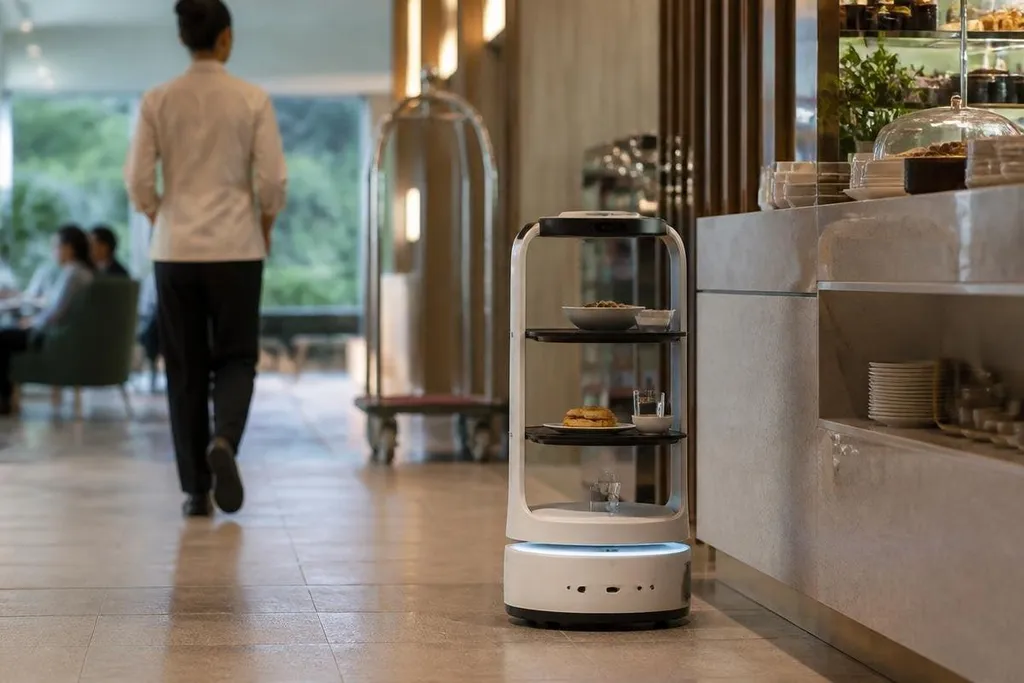
The biggest change in hospitality robotics may not be a new robot. It may be the shift from staged demos to machines doing repeatable work in hotels, restaurants, and airports. With no evidence pack supplied for this topic, a factual ranking would invent details, so this article sets out the proof each claim needs.
Quick read
- A robot matters when it completes a real hospitality task without constant staff control.
- The useful measures are task time, human help, safety stops, uptime, and total cost.
- A demo proves movement. A deployment record proves work.
Start with the task, not the robot
Hospitality work is made of small jobs. A robot might carry items, move through guest areas, clean a floor, deliver food, or support stock handling. Those tasks differ in weight, distance, noise, access, and contact with people, so one ranking cannot fairly cover them all.
A useful report should name the task first. “Autonomous delivery” says little on its own. A better claim would state what the robot carries, how far it travels, how often a person steps in, and where the system runs.
That detail matters to an operations manager choosing equipment for a hotel. A robot that works well on a flat corridor may struggle with lifts, narrow doors, carpets, guests, or a busy service area. The work sets the test.
What counts as a real breakthrough
A new robot earns attention when it changes a measured part of the job. That could mean fewer staff trips, faster room service, less lifting, or more consistent cleaning. Each claim needs a before-and-after measure from a named site.
The test should also cover the full shift, not one successful run. A machine can complete a task in a video and still need frequent charging, remote control, blocked-path recovery, or staff help at every handoff.
Safety belongs in the same record. The report should state how the robot detects people, what happens when a sensor fails, where the emergency stop sits, and who takes control during a fault. Hospitality robots work near guests, so a safe stop matters as much as movement speed.
The proof behind the headline
Hospitality claims need a named company, site, test, or deployment record behind them. Reporting on hospitality robotics can connect each claim to that record before the next section sorts evidence by source.
A strong article would separate four kinds of evidence. A product page can confirm a robot’s payload or battery rating. A customer statement can confirm where it operates. A video can show the task, though cuts and remote control need clear notes. An independent test can check whether the machine performs as claimed.
Cost also needs more detail than a purchase price. The calculation should include charging hardware, software fees, service visits, floor changes, staff training, and the time people spend helping the robot. Without those figures, no reader can compare a robot with the current process.
What remains unproven
Many hospitality robot claims will stay open until a public record answers basic questions.
How many units are working? For how long? What percentage of tasks finish without help? How often does the robot stop? Who pays for repairs?
A clear report can say that evidence is missing. That is better than turning a planned pilot into a working deployment or treating a short video as a full shift. The same rule applies to claims about labor savings: the numbers need a named site and a defined time period.
I’d rank repeatable work above polished demos, because a hotel buys completed tasks, not camera time.
A practical buying check
Use this list when a supplier presents a hospitality robotics claim:
- Name the task and the exact place where the robot will do it.
- Record the time per task before and after deployment.
- Count staff interventions, remote-control sessions, and safety stops.
- Check payload, battery time, charging method, doors, lifts, and floor types.
- Add purchase, service, software, training, and site-change costs.
- Ask which results come from a customer site rather than a controlled demo.
The strongest hospitality robotics story will be the one with a named site, a clear task, a measured result, and a public record of the limits. Until those details are available, the honest answer is that the biggest breakthrough has not been proven yet.